Showing posts with label Sand Traps. Show all posts

Saturday, June 7, 2025

2025 Summer Update

 The Spring of 2025 seems to have just flown by and in a couple of weeks we will welcome the official start of the 2025 Summer season with the Summer Solstice on Friday 6/20/25. Before this date we have a couple of big events to prepare for and then afterwards we have some planned turf conversion areas to develop just ahead of our summer fairway aeration week where the golf course will be closed. Below are some pictures highlighting some of what we have been up to in GCM as well as our plans through the first part of the Summer of 25.


Upcoming Summer Golf Course Maintenance Schedule Overview


June 9 through June 22 - Prepare and Host  MacKenzie Cup & California State Amateur

June 23 through July 6 - Prepare select areas on golf course for turf conversion

July 7 through July 11 - Aerify & Sand Topdress Hybrid Bermuda Fairways. Golf Course Closed


GCM Activities Spring of 2025


Springtime is always a busy time on a golf course as everything starts growing at once. One of the things that we've been working on in addition to mow, mow, mow is adding more sand to our bunkers. Adding a little sand to bunkers here and there is a normal maintenance function, however our bunkers needed some substantial sand refreshing since the 2021 renovation and we are just about finished.


Our driving range mats are scheduled for replacement on Tuesday 6/10/25. Invited Clubs has switched golf mat vendors to Fiberbuilt Golf. Predictably our concrete pad was to narrow by a few inches to accommodate the new Fiberbuilt Mats, so we had to add some concrete to existing pad. 


Our strategy of late has been to lay off projects Spring through the first part of Fall and concentrate our efforts on course maintenance but we couldn't help ourselves and installed a block of sprinklers along the rough edge on the left-hand side of #12 in May.

I've been mentioning this irrigation work ad nauseum because it is the infrastructure improvement that has been proven time and time again to produce the greatest results on this property. Any opportunity we have to check one of these areas off our Master Plan we will typically move on it even though the timing was not part of our overall spring through summer plan.


This is the rough between #15 & #13. If you can recall what this rough used to be like and what it is like today, it is because we now have supplemental irrigation heads surrounding it which has improved irrigation coverage and control allowing us to maintain cool season rough right next to warm season fairway turf facilitating the very different irrigation needs of both areas.  


We have deep spiked / aerified the greens along with associated sand topdressing a couple of times since the beginning of spring and the process is helping with rooting and firming of the greens and has kept with the small hole but frequent cultural practice strategy on our greens. Here Enrique is using a Vertidrain Aerator to spike 1/4" holes 8" deep into the surface.


GCM Planned Activities Summer of 2025


Part of our Master Plan is to convert some chronically bad areas on the golf course from cool season turf to warm season Santa Anna Hybrid Bermuda to facilitate cart traffic in certain entrances and exits on the course. These are areas that are adjacent to warm season turf that have never been right.

Hybrid Bermuda can only be established vegetatively or by live plant sprigs or sod. There is no seed for hybrid bermuda. We have a couple of weeks before we aerate the fairways after the Mac Cup and the CA State Amateur. Using the fresh cores from the fairway aeration process will be great way to establish hybrid bermuda, we just have to prepare the areas beforehand. 

Above is the drive off area of #13, a chronically bad traffic pinch-point. Our plan is to strip this area, condition the existing native soil with sand and compost, compact and grade then cover with fresh aeration cores. This has to be done in the summer when hybrid bermuda is actively growing. More details to come on this great opportunity to improve some chronically bad areas. 


Another area we plan to address with aeration cores is the narrow strip of rough along the cart path on #9.


Above is an area we plan to address with aeration cores as well.  It is the drive on to the fairway #12. Another area we will address which is not pictured is the drive on to #15 right after you cross the bridge.


Another part of our summer re-grassing strategy is to prepare a few select small areas for seeding in the early fall which require some weed eradication first.  The above photo is of Dallisgrass, a notoriously difficult perennial weed to control selectively, or by using a product that will kill the dallisgrass and not the desirable turf. It can overwhelm an area to the point where a scorched earth tactic is the most appropriate way to eradicate it. 

Dallisgrass is a perennial weed that goes dormant in the winter then comes back with a vengeance in the summer by way of a very robust root system. To eradicate the weed for good you have to kill the root system so multiple treatments are recommended so the areas we plan to address will remain bare until we seed them in late summer - early fall.


This area behind #15 tees is out of play and completely infiltrated with dallisgrass. We plan to treat this area  multiple times and afterwards seed with Tall Fescue in the late summer. Other areas we plan to address in this manner are the back slope behind #1 green and the left hand rough of #12 near the pond. All of these areas have a substantial amount of dallisgrass infestation that needs to be eradicated.


Getting Through the Summer of 2025
How Members Can Help


This is the left hand rough edge of #16 and it highlights one of the main challenges Granite Bay faces in the summer post 2021 renovation. We converted half of our golf course to Santa Anna Hybrid Bermuda and the rough remained primarily a blend of cool season turf grass varieties because of the shade issues associated with our tree lined holes.  These cool season turf areas are very susceptible to the heat of the Granite Bay summers.

How can you help?
The best way to help the course in the summer when operating a golf cart is entering and exiting though the gates and drive exclusively on the short cut fairway turf avoiding  the rough with cart traffic.


To protect the rough, we do plan to close a few holes at a time to cart traffic during the summer months. 


Additionally, you will notice some soaker sprinklers in areas that a bit stressed. We haven't experienced any mishaps with carts tangling up or running over these hose stands yet so thank you. 

Something to note is that the areas you notice these hose stands are areas that are outlined in our Granite Bay Golf Course Master Improvement Plan so one day there wont be such a need for hose-stands or as many cart restrictions in the summer.


Back to this image of the rough between #13 & #15. This is the goal for the entire course. Healthy cool season rough with its irrigation needs being met coexisting right next warm season fairway turf with it distinctively different irrigation needs being met. We are not that far away.


Thanks for your support!


Monday, May 22, 2023

New Sand, Sprinklers, Swans & Speed Signs

We are making our last push the next few weeks on what can be considered big golf course projects until after summer. This allows us to focus our recourses on maintaining and culturing the new warm season Santa Anna Hybrid Bermuda fairways and approaches as well as holding onto the new cool season Tall Fescue we have incorporated into our rough areas. We now have a 50/50 warm season - cool season golf course where half of it will thrive and need culturing in the summer while it is hot, and the other half will have to be babied with hand watering. There will always be some small little "low hanging fruit" projects that we will tackle, but starting anything big beyond routine golf course maintenance will be avoided until fall.

The current maintenance related non-routine projects I am referring to are the same ones mentioned last week, irrigation work on #13 and sand refreshing in the bunkers throughout the course. Completing the sand refreshing in the bunkers will take a while as it is turning out to be a more labor-intensive, time-consuming endeavor then anticipated with sand availability limitations as well. However, the big supplemental irrigation project on #13 we've been working on the past two weeks was completed this week. Below are some more pictures along with some Swan updates and a new "Speed Sign" that many of you will find fun. 


Above shows a set of sprinklers on the fairway edge recently installed in the upper right-hand rough of #13. These sprinklers water into the cool season rough only facilitating adequate irrigation for the cool season fescue without the need to overwater the warm season Hybrid Bermuda fairways. We installed three sets of these sprinklers covering the entire right hand rough edge on #13. The days of this area's substandard summer turf conditions should be a thing of the past.


Front bunker on #3 green has had its sand refreshed by adding the appropriate amount of sand, watering and compacting.


An important step in the refreshing process is checking sand depths. Above depicts Greg using a gauge for this purpose. Greg has been heading up this bunker sand refreshing process which is extremely labor intensive. Greg's one of the hardest working guys I know and GBGC is fortunate to have him.


Swan & Wildlife Update

Recent developments with our pair of swans deciding to take up residence at Granite Bay Golf Club have maybe reminded us of what we all have always felt about Granite Bay and how special this place is. Below are a few more examples of just that. 


Swan Nesting
 continues just adjacent to the #1 green in the bull rushes. I got a little closer trying to get a peek at the eggs but no luck yet. 


Came across this guy heading up #2 the other day and immediately relocated him to pond on #3.


Perhaps he reunited with his family later. Or she?


Dave Cook caught this picture of a bird box behind #11 tee being utilized by who Dave suspects are Wrens. We will check back in on this family later next week.


Posting Daily Green Speed

We started posting daily green speeds this week on a sign on the front of the starter station near the upper practice green. Green Speeds are a measurement in feet determined by the use of a tool called the Stimpmeter designed in 1935 by Edward Stimpson. The USGA Stimpmeter Instruction Booklet covers the history, use and the many management practices and conditions that effect green speed on a daily basis. I would encourage members who are interested in learning more about measurement of green speed to click on the above USGA link or look at the plethora of resources available on-line. They are endless. 


Sunday, May 14, 2023

Bunker Refreshing

 A complete re-building and re-shaping of our bunkers was a big part of our 2021 golf course renovation. We only reduced the number of on course bunkers from 65 to 66, but we  decreased the square footage from  88,000 to 65,000 while providing subtle redirection and framing of the same golf holes we all know and love.  Construction of the bunkers included the Better Billy Bunker drainage system, and the bunker sand choice was  Best Sand 900, formally known as Idaho White as the bright white sand originates and is shipped from Western Idaho. Best Sand 900 is not only known for this bright white color, but more importantly its angularity, making it a great choice for bunker sand as the particle shape produces a sand that compacts and resists buried lies, along with an innate ability to adhere to steep bunker faces. 

When sand was installed during construction, the target amount of sand was 4" to 6" packed on the bottoms as well as  2" on the bunker slopes or faces. Settling and further compaction of the sand as well as migration out of the bunker from wind and actual golf play along with sand contamination always necessitates the need to refresh and add bunker sand, so that is what we will be doing the next few weeks along with our normal routine maintenance tasks. A picture is worth a thousand words, so below are some of the sand refreshing process as well as an update on Swans and supplemental irrigation install.


Process starts with identifying where additional sand is needed then adding sand which is pictured above. 


Next step is to rake and disperse the sand.


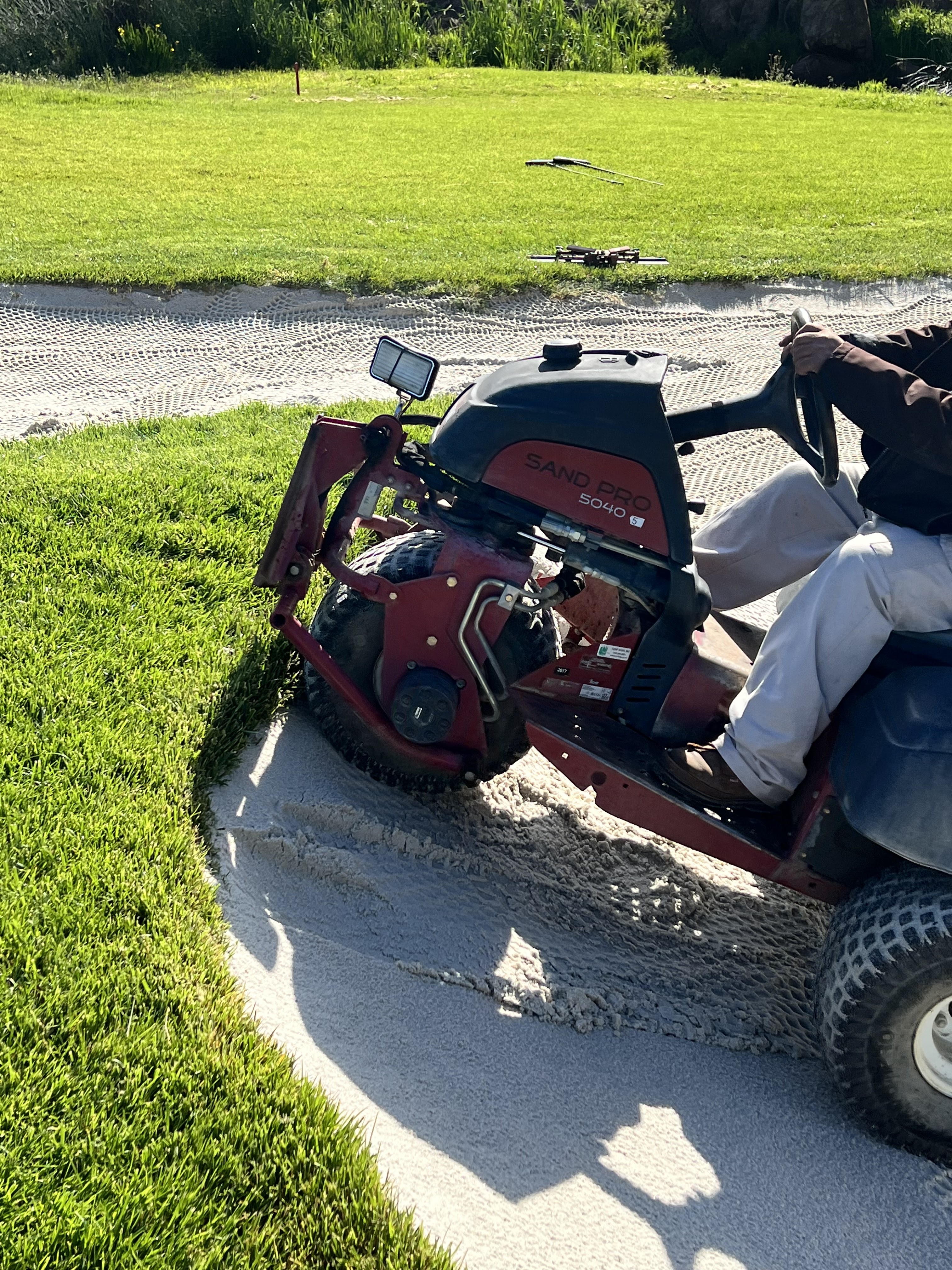
Next step is to compact the freshly installed sand. Above depicts the use of a mechanical sand trap rake with the raking mechanism removed. The tires are wide on this "Sand-Pro", which is what we refer to it by. These closely spaced wide tires make this compaction method a popular choice for compacting sand in a bunker.


Another closeup of the compaction process.

Supplemental Irrigation Installation

We started some supplemental irrigation work on #13 this week and will continue this work the following few weeks in addition to the above-mentioned bunker sand refreshing and normal golf course maintenance. This is a lot of work but all important. If you search your memory of past GBGC summers and envision the upper left-hand rough on #13, you should recall very thin conditions starting in late spring all the way through summer and most of the fall. This area has always been the first area to start to show summer stress on the course and some individual small supplemental irrigation heads that will irrigate these areas independently of the fairway turf will change this dynamic. 

Search your memory further and recall the cart path edge of #18. We installed this type of supplemental, irrigation heads years ago, and completely changed the area from one of the worst in the summer to pretty good in the summer. We want to get some of this done before the real heat arrives so this area will be another great example of the  importance of these measures as there will still be more to do after #13.


Trench along the fairway and rough line on the LH side of #13. This will transform this areas summer conditions.

Swan Update

Nothing much to report on the parents to be. Flying camera found them in the very same location as last report. Trying not to get too close and stress them out. 


The Best Is Yet To Come!   Thanks for your support.

Friday, February 17, 2017

Golf Course Maintenance Weekly 2/17/17

What To Do When It Doesn't Stop Raining?


You might have wondered what does the golf course maintenance staff do when all it seems to do is rain like it has been doing since the beginning of the year. Its too wet to mow or even get maintenance equipment out onto the golf course to dig drains or spread sand or do anything you might be thinking. Its true there is allot of normal maintenance activities that we cannot do when it is raining or sloppy wet as the course has become this winter, but we have stayed busy and productive setting ourselves up for success this spring when it finally stops raining. Below are some pictures of our recent progress on a couple of fronts.


The best time to do tree pruning for us in in the winter months and as long as it is not raining too hard we can make progress in the rain. Above is GCM working on trees along left hand side of #18  recently.  Below is the area between #14 green and #15 tee that needed some pruning making the fairway from the upper tournament tees more visible.


Irrigation Controller Install

Another project we have been working on is  Phase II of our Irrigation Controller Replacement. Rainy weather has hindered our progress but we have been diligent to work between storms to get this important project complete. Replacing our irrigation controllers (those grey boxes spread out around the course) not only proactively replaces 20 year old electronics, but also gives us more pin point irrigation control because we can add stations and split up sprinkler heads. This "single head coverage" allows for a better distribution of irrigation water leading to better turf conditions.


                                           Preparing for new concrete pedestal


                                                                                    Sometimes improvisation is necessary when the rain just                                                                             wont stop


Pouring concrete between storms


                                         Finished Product

Between the Storms

When it stops raining and we look forward to our Members returning to the course we have to recover the sand traps from the previous rainstorm. Of course not all rainstorms are equal. Heavier rain that falls quickly usually causes the most wash outs and damage. Lighter, sustained rain gets and keeps everything wet, but is less likely to wash out the traps.


This is the results of a heavy storm


                                                         Bring out the pumps


Enrique pushing up the wet displaced sand before raking.


The Rising Creeks


When it rains of course, the creek rise. Below are some pictures of Linda Creek running through the course directly after a heavy downpour.


Linda Creek entering our property near the bridge on #4


Linda Creek running into our irrigation pond just behind #4 green.


Linda Creek exiting our irrigation pond under the bridge on #1


Subsurface drainage sheeting across the turf and dumping into Linda Creek near the bridge on #16 & #15


Linda Creek running right in front of #16 green.


The other side of the bridge on #16. Notice the accumulation of azolla  (red floating mat that was in the main irrigation pond between #1 & #9). Good riddance.