Wednesday, July 26, 2023

Summer of 2023 Fairway Aeration & Sand Topdressing

We have recently completed our scheduled fairway aeration and topdressing on the back nine and are almost complete with the front nine. Our new Santa Anna Hybrid Bermuda fairway turf is a warm season grass that will recover rapidly during the warmer weather of summer.  In 2024 we are going to schedule our spring aeration and fairway topdressing closer to the end of spring when the warmer recovery weather will be more predictable then in April.

This aeration was the first core aeration to these fairways since they were sprigged in the summer of 2021. This process will be very beneficial to the overall health and performance of these new fairway surfaces and will allow for  more consistent  moisture throughout the soil profile. Additionally getting another 30 to 40 tons per acre of sand topdressing down will continue to smooth and fine tune these surfaces. This will be the 4th sand topdressing since sprigging in 2021, and we have noticed a difference in fairway smoothness after each one of them. They will continue to get better with each subsequent topdressing in the years to come. Below are pictures of the process we employed this past week.


First step is to flag all of the sprinkler heads, valve boxes and yardage markers so tractor operator can hopefully avoid them. I spent allot of time on one of our two fairway aerators, The Toro Procore 1298, and can share a couple of  things. First the Procore is a wonderful, state of the art  fairway aerator that feels like your pulling a sewing machine when the soil conditions are good, but when the soil conditions are not so good, which is vastly more often then not on our property, it feels like your pulling a cluster bomb. Its was a not so subtle reminder of the main overall challenge of this property, the native soil.  Secondly avoiding all those sprinkler heads, valve boxes and yardage markers  identified with the little white flags is another challenge all unto itself.

  Above is a good image of the actual aeration process. We uses 3/4" coring tines that were penetrating as deep 2"- 3", depending on the soil, so yes more 2" depths then 3".


Above is a closeup of the actual cores pulled during the process and the holes awaiting to be filled with sand, then irrigation so it can penetrate and soak and hydrate the profile.


After the cores have been allowed to dry for awhile, we use a keystone drag mat to break up the cores. Some of the soil we are trying to extract and replace does remain because of this but it mixes with the organic matter and subsequent sand topdressing making it a much better growing medium.


Next we start to use our turbine blowers to wind row the cores and debris for removal as well as clean the surface after sweeping and mowing.


Next comes the sweepers which sweep up all of the cores and debris 


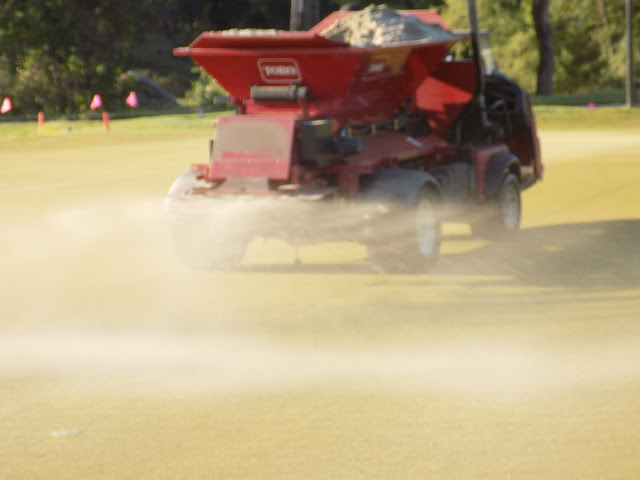
After cleanup, The Man, The legend, Enrique Reyes Huerta starts to topdress with topdressing sand. This represents an application rate of  about 30 to 40 tons of sand per acre.


The sand is allowed to dry then we start to drag it into the aeration holes and turf canopy with the same keystone mat that we used to break up the extracted cores


Prior to aeration we turn off irrigation for a day or two. So after the sand is properly drug in, we irrigate fairly heavily, (0.30" - 0.50"),  to push the sand further into the aeration holes and turf canopy as well as hydrate the soil profile. The following day we apply fertility and wetting agents to help out further irrigation events and promote recovery.


#12 Fairway on Tuesday 7/25/23. We core aerated & processed this on Tuesday 7/18/23 7 days prior and topdressed on Wednesday 7/19/23  only 6 days prior. The nature of the warm season Hybrid Bermuda recovers very rapidly during the long days and warm weather of summer. 


Closeup of this recovery 7 days out from actual core aeration event.


The Best Is Yet To Come

Summers have always been hard on this golf course as the heat of summer combined with the native soil conditions have proven difficult to consistently overcome. Our new Santa Anna Fairways are more tolerant of the bad soil conditions and continued timely aeration and sand topdressing will just continue to make these summer loving surfaces better and better. The addition of Tall Fescue to our cool season rough will help with summer hardiness, but the tried and true solution for our cool season rough in this suspect soil when summer comes is improving irrigation coverage to ensure consistent & adequate soil moisture, keeping the soil profile from drying out. It's only worked every where we have done it.

Thanks as always for your support


Friday, July 7, 2023

Fairway Aeration & Seed Head

Our fairway turf conversion in 2021 from cool season turf to warm season hybrid bermuda included the choice of  Santa Anna Hybrid Bermuda as our warm season turf choice. If you recall, we chose Santa Anna because it held onto its color longer and came out of winter dormancy sooner then any of the other hybrids we were sampling. One of the knocks on Santa Anna though is its propensity to to produce seed head and the seed heads associated stalks. 

We can mitigate this seed head production with growth regulators, and were successful through June in doing so and honestly thought the applications we made were going to suffice all season. However we learned quickly it is a futile task  attempting to out smart nature, and almost overnight our fairways exploded with seed head. We all need to be reminded on occasion that the field that we play the game that we love on, is a living breathing complex organism that will do what it does despite our efforts at times and you just cant fool mother nature. 

The seed head  of hybrid bermuda is sterile. It wont even germinate or make another plant, its just unsightly, especially from afar. When your standing over the top of it the tan coloration is not that evident but from afar the fairways as a whole take on a tannish hue.  We have treated it with another application of growth regulator which will help mitigate the appearance in a short period of time we hope. Scheduled core aeration and sand topdressing will help as well.


From afar the hue of the accumulated seed head seems tan or yellow in color and looks like there is something wrong or the fairways are stressed out.


But when you are standing over your ball you see healthy turf and a pretty good lie in most instances.


Laying down you can really see up close what is going on. Some of the seed stalks, which are tan or yellow in color, are sticking up but many are lying down, and the accumulation of these are what gives us the overall tan appearance from afar. Pesky seed heads!


2023 Summer Fairway Aeration

Our scheduled fairway aeration is coming up in mid July. The golf course will never be completely closed as we will only work on nine holes at a time so there will always be nine holes available to our Members. Our plan this summer is to core aerate, drag the cores, mow then sand topdress, then drag the sand topdressing in. I'll provide plenty of pictures of the process when we get started. Below is a schedule of the work and associated closures.


Tuesday 7/18/23 - Thursday 7/20/23 B9 Closed for Aeration. F9 Open
Monday  7/24/23 - Wednesday 7/26/23 F9 Closed for Aeration. B9 Open


This is us aerifying #6 fairway in April of this year. We utilized solid tines that application. We will be pulling cores this coming application.


Swan Update


Nature is exacting and it was stated in a previously  linked bird fact article on swans "around 50% of cygnets fail to survive longer then 2 to 3 months." So far that statement is true for our new family of cygnets, as we started with six and now have three. 


Recent photo of the abbreviated family near ladies tee on #1.


Sunday, June 4, 2023

Swan & Sod News

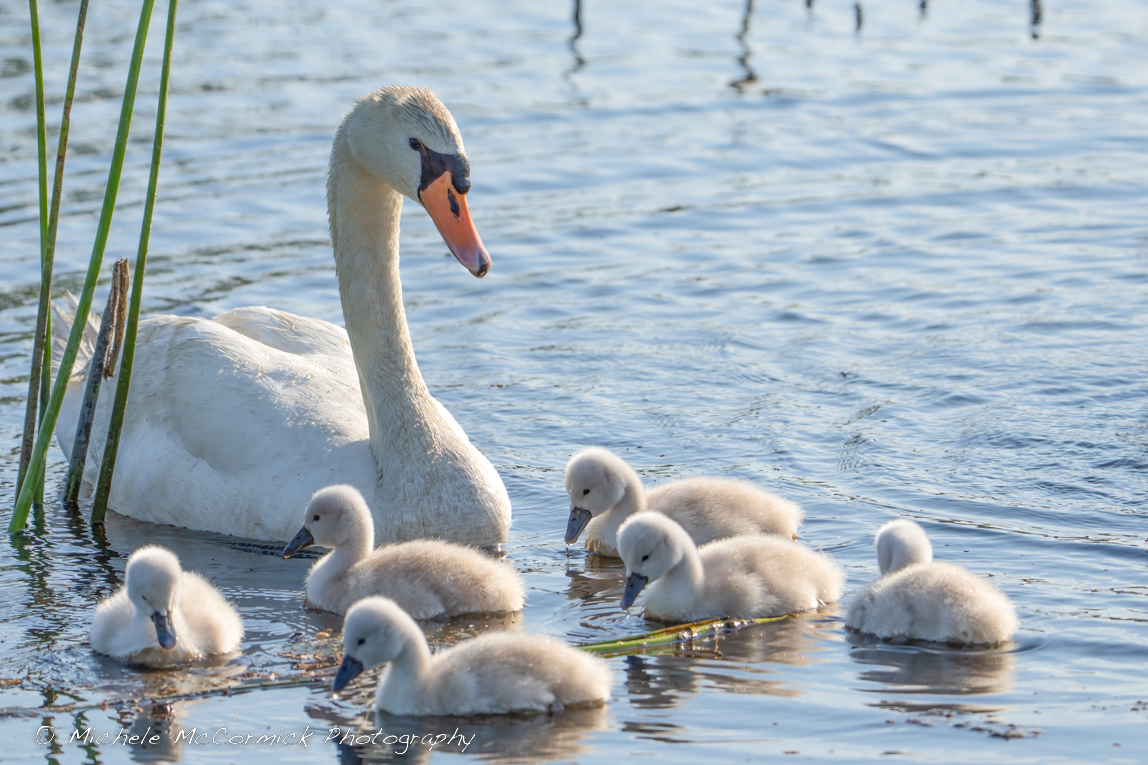
We have many great artists and resources who are Members here at Granite Bay, but we'd be challenged to find an equal to Michele McCormick in photography and Birding. Michele frequently visits the course on closed Mondays to get spectacular photos of Birds, Wildlife and Interesting Plants so I contacted her to inform her that our Mute Swans had hatched their cygnets. She jumped at the opportunity to get some shots of the new arrivals last Monday. She spent the day out here and documented  31 Bird Species this visit.

Additionally she  let me know that she catalogs her findings with eBird, a site that catalogs birding activities, photos and species migration from collaborators all over the world. And through Michele's passion and skill, Granite Bay Golf Club is contributing to science and conservation on a global scale. We are blessed to have her as a part of our community. Below are what Michele deemed some of her best shots of the day. 


Coopers Hawk

Besides the great photos of the swans, we received a bonus through Michele's efforts as she captured a first at Granite Bay, a Coopers Hawk. Michele told me it  "Was fun to get the Swan pix but I was even more excited about the Coopers Hawk and chase! There were actually two Coopers. Here’s the juvenile."


"Here's something you don't see every day - A Cooper's Hawk determined to have an Acorn Woodpecker for lunch. It was like something out of Top Gun! Near #3 green. mm"


Links

Michele McCormick Photography

Cornell University's eBird


Sodding Behind #2 Green

One area of turf on the course that never really fared well nor came out of winter was behind #2 green. Shade of the large oak tree behind the green was the main culprit but there were some inherent bad soil issues in the area as well. Shade and suspect soil are a bad combination for growing anything much less hybrid bermuda turf.

We stripped out the worst section this past week, conditioned the soil and re-sodded the area with new Santa Anna Hybrid Bermuda. We plan to get some tree trimming done in the area to alleviate the shade issues as well, allowing more sun to get into the area particularly, in the winter. Time will tell if this will be the permanent solution for the area, but the turf will certainly have a better chance with the soil modifications and future tree trimming. Below are some pictures.


Adding compost and sand blend


Rototilling the blend into our native soil


Conditioned soil


Grading and preparing for sod


Re-sodded


Saturday, May 27, 2023

The Cygnets Have Arrived

Congratulations to all of us new step-grandparents. as our adopted pair of  Mute Swans have hatched their first flock of cygnets. The linked article, Baby Swans: All You Need To Know is a very informative article. If you're interested you should checkout and prepare for what comes next with our new arrivals. We will of course document what we can.

In other golf course news, we deep tined and sand top-dressed greens this past Monday 5/25/23. Pictures below are worth a thousand words. 


The first sighting of the hatched Cygnets was Friday 5/27/23 by Ken Roberts captured here. 


I immediately put the flying camera up to confirm our numbers and am happy to report we currently have six healthy Cygnets. 


Here they are a day (?) old on Saturday 5/26/23 frolicking and feeding with their parents. Photo captured by GCM employe partner Amanda Bergstrom.


This photo was taken Monday 5/22/23 before we became aware of the new arrivals. Geese were nearby on #9 fairway and possibly chased out of the pond by protective parent. 


Other GBGC Wildlife News


I suspect the pair above or at least the brown wren were the parents of the eggs in birdbox behind #11 tee that I highlighted last week. This was taken right above the location of the bird box. 


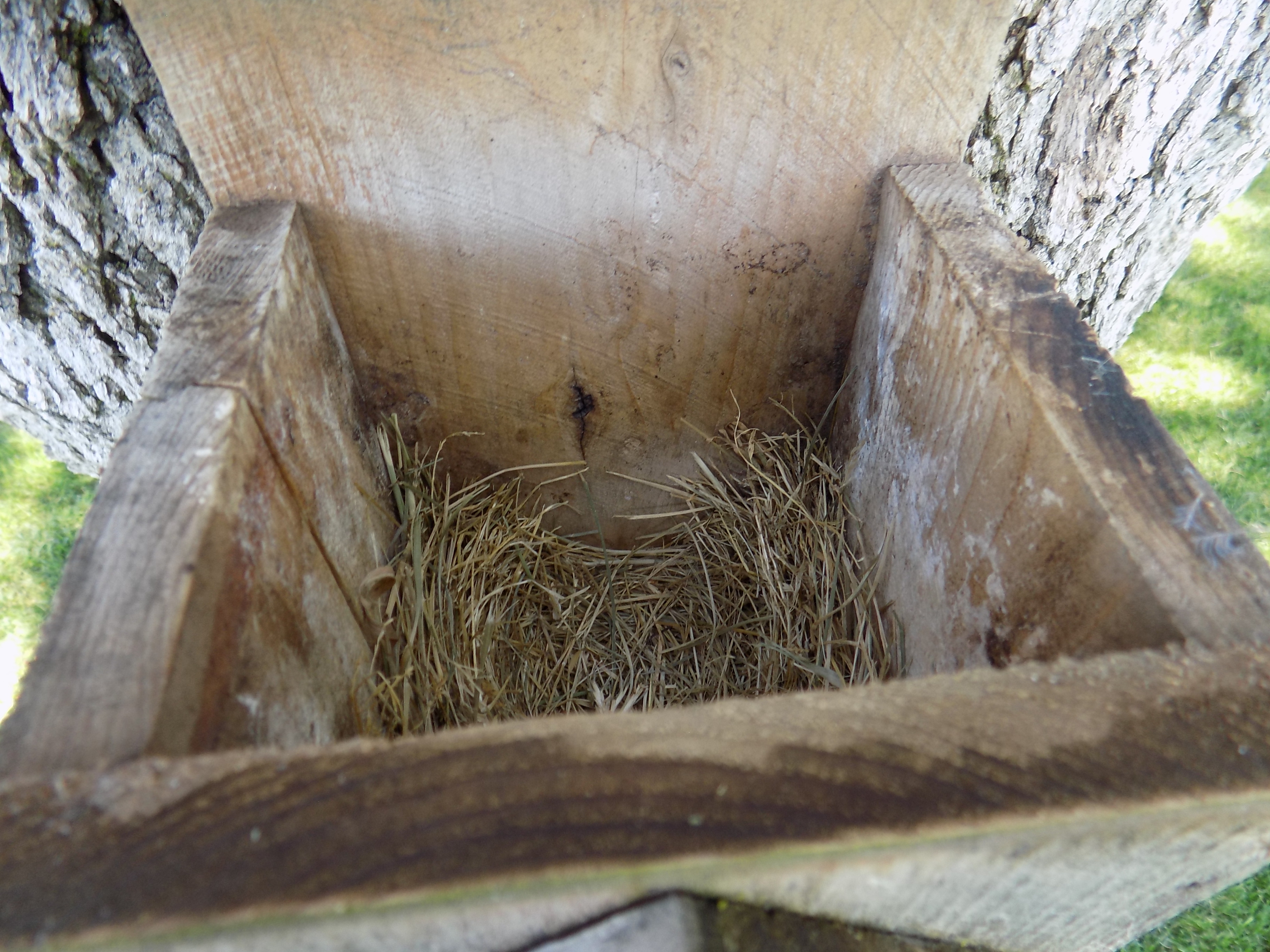
Unfortunately, when I checked the birdbox on Friday it was empty with no remnants of shells or anything in or below the nest. I thought parents might have moved the eggs because of my poking around and then  found out that wrens will move eggs for various reasons. Check out the below link.

Wrens Can Be Nasty Neighbors


Deep Tine Aeration


Enrique deep tineing or aerating the greens on Monday 5/25/23. 


These long tines penetrate 4 to 6 inches into the putting surface allowing much needed air to the rootzone facilitating deeper irrigation infiltration at the same time. Great practice that doesn't effect putting quality. This and similar practices need to be done frequently if we are going to avoid the more traditional, aggressive aeration practices in the future.


As you can see here this practice will not affect putting quality.


In addition to, and even more importantly, if we are going to avoid aggressive core aeration in the future with these new green's, we will need to frequently apply light dustings of sand to dilute the organic matter that a bent grass putting surface produce's naturally. The targeted amount of sand prescribed by the USGA Annual Sand Topdressing Amounts is anywhere between 25 and 30 cubic feet of sand per 1000 square feet per year. We are targeting 30. The above and below pictured application represents approximately 1 cubic foot per 1000 square feet. It is difficult to achieve 30 cubic feet per year just with light topdressings like this. It is easier to achieve if you aggressively aerate twice per year, but we are trying to avoid that if possible. We will need to get a little more aggressive with aeration such as a closer pattern of holes of either solid or coring to A - mechanically remove organic matter and B - allow for more topdressing sand incorporation helping reach the target of 30 cubic feet of sand per year.


After the 1 cubic foot application of topdressing we typically brush the sand into the putting surface followed by a little irrigation to push it down further, and a deep irrigation cycle the proceeding evening to push it even further. The next morning, we typically roll and blow the greens only to mitigate sand harvesting with the mowers, then try to roll first followed by mowing in the subsequent mornings which helps with the sand harvesting by
the mowers as well.


The Best Is Yet To Come. Thanks for your support!


Monday, May 22, 2023

New Sand, Sprinklers, Swans & Speed Signs

We are making our last push the next few weeks on what can be considered big golf course projects until after summer. This allows us to focus our recourses on maintaining and culturing the new warm season Santa Anna Hybrid Bermuda fairways and approaches as well as holding onto the new cool season Tall Fescue we have incorporated into our rough areas. We now have a 50/50 warm season - cool season golf course where half of it will thrive and need culturing in the summer while it is hot, and the other half will have to be babied with hand watering. There will always be some small little "low hanging fruit" projects that we will tackle, but starting anything big beyond routine golf course maintenance will be avoided until fall.

The current maintenance related non-routine projects I am referring to are the same ones mentioned last week, irrigation work on #13 and sand refreshing in the bunkers throughout the course. Completing the sand refreshing in the bunkers will take a while as it is turning out to be a more labor-intensive, time-consuming endeavor then anticipated with sand availability limitations as well. However, the big supplemental irrigation project on #13 we've been working on the past two weeks was completed this week. Below are some more pictures along with some Swan updates and a new "Speed Sign" that many of you will find fun. 


Above shows a set of sprinklers on the fairway edge recently installed in the upper right-hand rough of #13. These sprinklers water into the cool season rough only facilitating adequate irrigation for the cool season fescue without the need to overwater the warm season Hybrid Bermuda fairways. We installed three sets of these sprinklers covering the entire right hand rough edge on #13. The days of this area's substandard summer turf conditions should be a thing of the past.


Front bunker on #3 green has had its sand refreshed by adding the appropriate amount of sand, watering and compacting.


An important step in the refreshing process is checking sand depths. Above depicts Greg using a gauge for this purpose. Greg has been heading up this bunker sand refreshing process which is extremely labor intensive. Greg's one of the hardest working guys I know and GBGC is fortunate to have him.


Swan & Wildlife Update

Recent developments with our pair of swans deciding to take up residence at Granite Bay Golf Club have maybe reminded us of what we all have always felt about Granite Bay and how special this place is. Below are a few more examples of just that. 


Swan Nesting
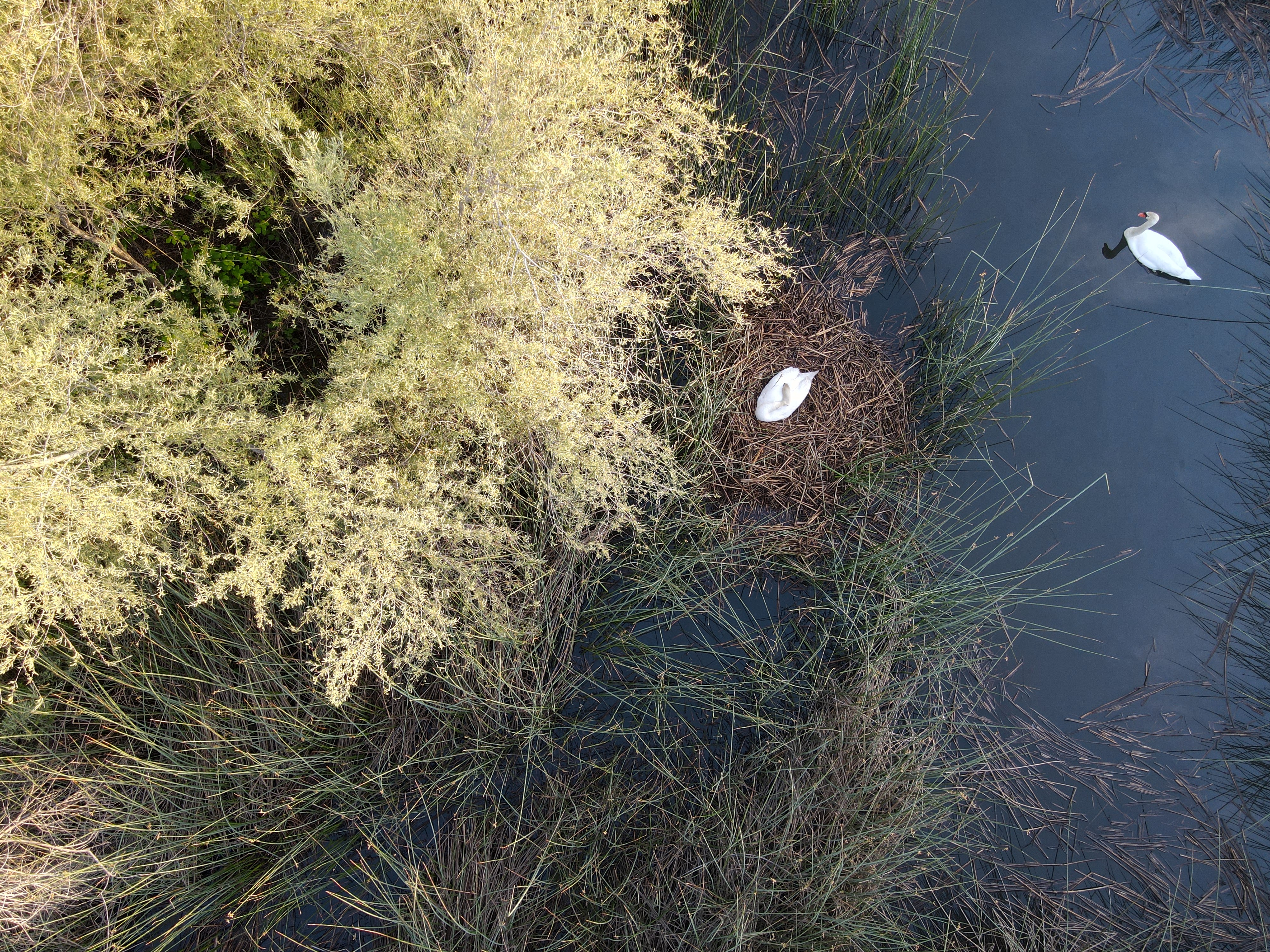
 continues just adjacent to the #1 green in the bull rushes. I got a little closer trying to get a peek at the eggs but no luck yet. 


Came across this guy heading up #2 the other day and immediately relocated him to pond on #3.


Perhaps he reunited with his family later. Or she?


Dave Cook caught this picture of a bird box behind #11 tee being utilized by who Dave suspects are Wrens. We will check back in on this family later next week.


Posting Daily Green Speed

We started posting daily green speeds this week on a sign on the front of the starter station near the upper practice green. Green Speeds are a measurement in feet determined by the use of a tool called the Stimpmeter designed in 1935 by Edward Stimpson. The USGA Stimpmeter Instruction Booklet covers the history, use and the many management practices and conditions that effect green speed on a daily basis. I would encourage members who are interested in learning more about measurement of green speed to click on the above USGA link or look at the plethora of resources available on-line. They are endless. 


Sunday, May 14, 2023

Bunker Refreshing

 A complete re-building and re-shaping of our bunkers was a big part of our 2021 golf course renovation. We only reduced the number of on course bunkers from 65 to 66, but we  decreased the square footage from  88,000 to 65,000 while providing subtle redirection and framing of the same golf holes we all know and love.  Construction of the bunkers included the Better Billy Bunker drainage system, and the bunker sand choice was  Best Sand 900, formally known as Idaho White as the bright white sand originates and is shipped from Western Idaho. Best Sand 900 is not only known for this bright white color, but more importantly its angularity, making it a great choice for bunker sand as the particle shape produces a sand that compacts and resists buried lies, along with an innate ability to adhere to steep bunker faces. 

When sand was installed during construction, the target amount of sand was 4" to 6" packed on the bottoms as well as  2" on the bunker slopes or faces. Settling and further compaction of the sand as well as migration out of the bunker from wind and actual golf play along with sand contamination always necessitates the need to refresh and add bunker sand, so that is what we will be doing the next few weeks along with our normal routine maintenance tasks. A picture is worth a thousand words, so below are some of the sand refreshing process as well as an update on Swans and supplemental irrigation install.


Process starts with identifying where additional sand is needed then adding sand which is pictured above. 


Next step is to rake and disperse the sand.


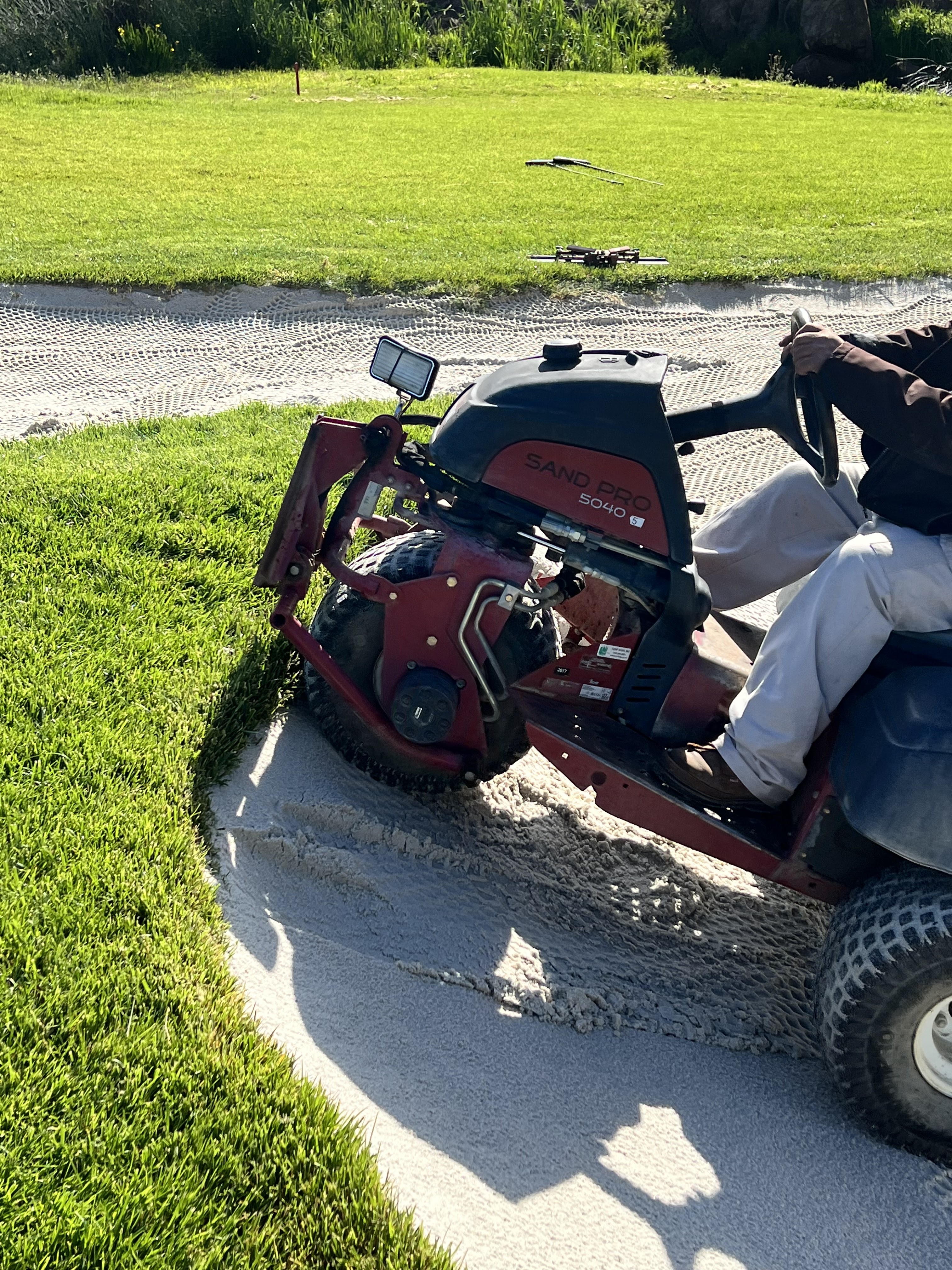
Next step is to compact the freshly installed sand. Above depicts the use of a mechanical sand trap rake with the raking mechanism removed. The tires are wide on this "Sand-Pro", which is what we refer to it by. These closely spaced wide tires make this compaction method a popular choice for compacting sand in a bunker.


Another closeup of the compaction process.

Supplemental Irrigation Installation

We started some supplemental irrigation work on #13 this week and will continue this work the following few weeks in addition to the above-mentioned bunker sand refreshing and normal golf course maintenance. This is a lot of work but all important. If you search your memory of past GBGC summers and envision the upper left-hand rough on #13, you should recall very thin conditions starting in late spring all the way through summer and most of the fall. This area has always been the first area to start to show summer stress on the course and some individual small supplemental irrigation heads that will irrigate these areas independently of the fairway turf will change this dynamic. 

Search your memory further and recall the cart path edge of #18. We installed this type of supplemental, irrigation heads years ago, and completely changed the area from one of the worst in the summer to pretty good in the summer. We want to get some of this done before the real heat arrives so this area will be another great example of the  importance of these measures as there will still be more to do after #13.


Trench along the fairway and rough line on the LH side of #13. This will transform this areas summer conditions.

Swan Update

Nothing much to report on the parents to be. Flying camera found them in the very same location as last report. Trying not to get too close and stress them out. 


The Best Is Yet To Come!   Thanks for your support.

Friday, May 5, 2023

Swan Update

After the appearance in February of  a pair of visiting Mute Swans on our #1 & #9 pond we all were hoping they would consider taking up permanent residency here at GBGC. Their added novelty & beauty, along with the potential hazing possibilities of their distant cousins, the pesky pooping  Canada Geese, would make them a welcome addition to the Granite Bay ponds. We started to get a little worried that perhaps a predator got to one of the pair a few weeks ago, as only one had been spotted in recent weeks. We are happy to report that that is not the case and they will be here awhile longer as they are nesting in a secluded little bay near the #1 green.


We don't know how many eggs they are sitting on right now, but will report back when we have more photographic evidence. However it looks like we will be observing a family soon, and maybe have at least a pair around for some time after that. 

I gleaned from the Wikipedia linked article above that:


"Mute swans nest on large mounds that they build with waterside vegetation in shallow water on islands in the middle or at the very edge of a lake. They are monogamous and often reuse the same nest each year, restoring or rebuilding it as needed. Male and female swans share the care of the nest, and once the cygnets are fledged it is not uncommon to see whole families looking for food. They feed on a wide range of vegetation, both submerged aquatic plants which they reach with their long necks, and by grazing on land. The food commonly includes agricultural crop plants such as oilseed rape and wheat, and feeding flocks in the winter may cause significant crop damage, often as much through trampling with their large webbed feet, as through direct consumption.[24] It will also feed on small proportions of aquatic insects, fish and frogs.[25]"

"Mute swans lay from 4 to 10 eggs. The female broods for around 36 days, with cygnets normally hatching between the months of May and July.[46] The young swans do not achieve the ability to fly before about 120 to 150 days old. This limits the distribution of the species at the northern edge of its range as the cygnets need to learn to fly before the ponds and lakes freeze over."


"The Swan is known around the world for its beauty, elegance, and grace.

The swan is a genus of waterfowl that has the ability to swim and fly with incredible speed and agility. This bird is also very intelligent, devoted to its mate, and highly aggressive about defending its young. They are a common sight in temperate and colder climates around the globe." (az ANIMALS)